I have my first podcast episode up! The title of the podcast is “Okay Boomer” and I dive into takes “boomers” make about the Gen-Z because they have a lot and most are not true. This is a podcast to separate fact from fiction about what people say about Gen-Z. Hope you like it!
Author: charliebaird
Final YouTube Video
My final project is up. Go check it out! I take a deep dive into the world of NFL film analysis on YouTube. What these people do is actually very different from normal game broadcasts.



Podcasts Analysis
Over the past year, I have become an avid podcast listener and enthusiast. I first discovered the world of podcasting while doing lawn work last summer. I was scrolling through Spotify, trying to find music to listen to but was sick and tired of all my playlists. So instead, I tried a podcast to change things up. Since then I’ve found a variety of podcasts I enjoy listening to and probably listen to an average of four a week. Today I will share with you some of the few I listen to.
I listen to primarily sports podcasts. Three of my favorites are Sin the Fields, Pardon My Take, and Windy City Gridiron. Pardon My Take is the most general, all encompassing sport podcast of the three. Produced by Barstool Sports, the hosts Big Cat and PFT along with their producer Hank talk about anything going on in the major sports world while not taking themselves too seriously. Sin the Fields is an ultimate frisbee podcast hosted by Pat and Tad that, similarly to Pardon My take, tries mostly to make jokes and keep the discussion light. They are produced by UltiWorld, the leading face of journalism in the ultimate frisbee world. Lastly, Windy City Gridiron is a more unique format of podcast. They are an umbrella for four different podcasts, all hosted and produced by employees of WCG. They all cover the same topic: the Chicago Bears. While all the podcasts are hosted by different people, they generally talk about the same things week to week.
In comparison to The Daily and Call Your Girlfriend, only Pardon My Take could match their production value. PMT has their own studio where they record their episodes, so conversation sounds natural and fluent. Obviously this is not the case right now because of Covid-19, right now they are over Skype. Regardless, this allows for more enjoyable and entertaining conversation like in The Daily or CYG. They have an intro song, Electric Avenue, that they play each episode along with little sound bites they use as transitions between segments. WCG and Sin the Fields, however, are of a much lower production value. Both of these are over Skype or some other video calling software. This creates a much more scripted feel to the conversation where one person says what they are thinking then turns it over to the other person to avoid awkward interruptions. The conversation is still enjoyable, but you can tell things are easier in person. Besides the conversation, the only other sound that is used are the intro songs, but these change every podcast and are not iconic like Electric Avenue is to Pardon My Take.
I definitely feel the sense of intimacy with the podcasts that we talked about in class. I feel this especially with Pardon My Take because I have listened to that podcast the longest. When they make inside jokes in reference to past shows and I understand them, it makes me feel like a part of a small group. I also follow the hosts on twitter, so I feel super close to them as I follow their activity online. This also helps me gets more out of the podcasts when they reference things they have tweeted about. Additionally, I agree on the point of the feel of de-professionalization in podcasts. Especially with WCG and Sin the Fields, the whole podcast just feels more relaxed and unprofessional than anything on the radio or TV because of the lack of structure. I enjoy this because it makes the hosts seem more like regular guys like me.
What I enjoy about podcasts compared to other media outlets is that they are the easiest way to get the content I enjoy the most. All the podcasts I listen to are focused on a particular interest of mine. It fun to know you can always get more content on these interests whenever a new episode of the podcast comes out. While I could get this content from a news article on some of the publishers’ websites, it is much more time consuming to sit down and read when I could listen and multitask with something else. Furthermore, I cannot get the dialog on topics of my interest in things like news articles either. Podcasts are the media of the future and I would encourage everyone to give one a listen.
Feedly Day Three
Today, the general news topics are similar to what they were yesterday. All news sources are covering the corona virus as it continues to spread all over the world. All countries, especially European countries, are now on high alert as it is becoming more and more prominent in their continent. Many events are now being questioned if they are safe to hold now due to the risk of infecting other countries. The Olympics, for example, may not be held this year if the virus is not under control soon. Economies are also being hurt by this outbreak. US investors seem very working about the stock market and how many stock prices are beginning to drop.
This article in the Virginian Pilot is another clear example of an inverted pyramid structure of story telling. This article is about the democratic race for the candidacy to run against Trump in the state of Virginia. This story has a special tie to home because CNU did the data-gathering for the numbers in the story. This story starts off once again with the most important information. Biden is currently leading the state of Virginia with 22% of voters, followed by Sanders at 17%, Bloomberg at 13%, and Warren at 8%. These statistics are clearly the most important information of the article and this are first in the article. The article then ends with some less-important data about what the margin of error is and what might change in these numbers in the future.
This article by Cleo-Symone Scott demonstrated her taking on the role of Community Manager as a journalist. This article explains the marine rescue training going on in Hampton Roads and communicates with members participating why the training was named after the Murdered Chesapeake Police Officer. She is moderating a conversation about a community incident to give more explanation to everyone in the community.
Feedly Day Two
Today, the stories seems to have a much larger spread of topics than the last time I checked Feedly. I believe this is due to the fact that no major political incident has happened the night before like we saw last time with the democratic debate. However, there are still two lose similarities I can see still formed. The first is Mike Pence being put in change of the US’ fight against coronavirus. Many people seem to be upset with this decision because now all scientists in America working on this issue must give the results of their findings to Pence and he delivers it to officials across our borders. The other major similarity I see is initial stories coming out of the NFL scouting combine. As one of America’s most viewed sport, seeing the upcoming draft class display their skills will always draw attention.
This article by ProFootballTalk follows a clear inverted pyramid structure. The article is about the new proposed CBA (Collective Barring Agreement) and how it will penalize players even more for holding out of practice while waiting for a new contract. The article starts by sharing the different things that will change with this new CBA. All these changes are meant to stop the players from holding out of practice and games. The players do not like this because it gives them less leverage in the contract discussions. The article then finishes up by giving details that are not nearly as important.
Lisa Vernon Sparks is playing the role of researcher guide as a journalist in her article about Magruder Boulevard to Neil Armstrong Parkway. This title does not give the reasoning away for this change, and Lisa makes sure to organize the information on why this name change is coming so it is easy for the reader to understand. She verifies that is is because Magruder was a confederate general and not someone to be remembered. Since it is the 50th anniversary of the first man on the moon this year, it makes sense to change the name to Neil Armstrong.
Live-Blogging the CNU Presidential Forum
As the Democratic Presidential candidacy continues to heat up, the topics of discussion are being brought onto our very own campus for students to get a first-hand impression. All six front-runners; Sanders, Warren, Buttigieg, Biden, Bloomberg, and Klobuchar, will have campaign surrogates to represent their candidate in a presidential forum. While Bernie is thought to be wining the race, all of the candidates still have a shot at this point. This forum will be a great way for students to learn more details about each candidate and get a better feel for what makes each of these candidates different from one another.
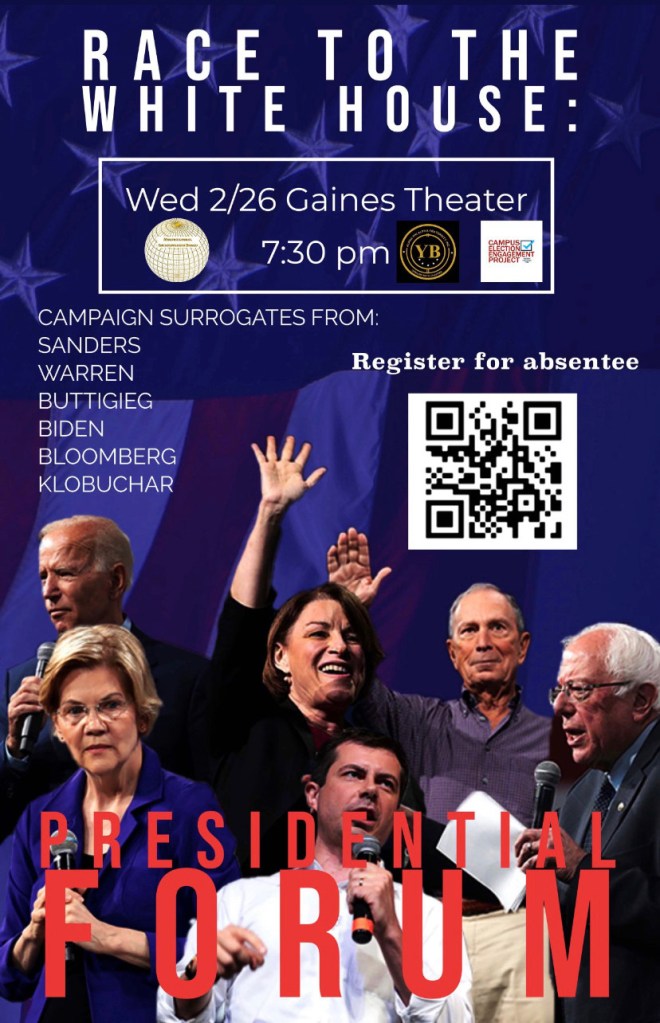
7:35 – Forum about to start, looks like Bernie’s surrogate will not make it tonight.
7:41 – Based on the crowd chatter, many people are here just to become educated on the candidates. This seems to be the main audience for this event.
7:45 – Surrogates introducing themselves now. Looks like the Bloomberg surrogate could not make it either.
7:51 – Representative from Senator Mark Warner’s campaign has been given the mic to make a case for him in the ballot for being reelected. He is emphasizing the work he has done in the public school system.
7:53 – First question is finally asked. How will your candidate work for a more inclusive America? I am expecting to see lots of attacks on the 1% especially without Bloomberg representative.
7:58 – Klobuchar’s surrogate seems to be taking an approach of distinguishing her as better than all other candidates rather than just answer the questions on her behalf. Biden’s is emphasizing the fact that he is the answer to beating Trump.
8:03 – Though it is early, Warren’s surrogate is clearly dominating this forum. She is doing the best job at applying her candidate’s plans to the community she is talking to and has the best public speaking skills of the group.
8:05 – I was correct. Everyone going after the top 1%.
8:08 – Current question posed is what the candidate will do for the economy as a whole along with education specifically. Seems like all candidates represented here are fighting for some form of paid higher education. I am finding out Biden is not in this group as I write this. They all agree that a great economy starts from a strong educational foundation.
8:12 – My favorite question so far just dropped. What is your candidate’s plan to fight climate change? I am sure this will have a lot of overlap between candidates as this is a topic of high interest across the party.
8:18 – Buttigieg, and Warren all are looking for a quicker timeline while Klobuchar and Biden aiming for 2050. Warren stands out from the others though by promising to attack environmental racism in places like Flit Michigan.
8:26 – Klobuchar’s surrogate is pushing the point home that she is a compromiser at heart and will work to implement new policy slowly. He is portraying her as the one most willing to reach across the house to work with the republicans to get things done.
8:29 – The surrogates are all being very friendly to each other which is nice to see. At the debates, everyone was at each other’s throats. However, this is not the case here which is nice to see. A friendly discussion makes taking in information a ton easier.
8:34 – Buttigieg’s surrogate is not giving him a great look. On the topic of DACA, she does not know his policy and is seeming to be a little unprepared.
8:38 – Bloodbath on the DACA question. Only Warren’s surrogate was informed on her candidate’s exact stance on it. Klobuchar’s surrogate especially slipped up calling migration the same on emigration.
8:45 – All candidates agree that decreasing our foreign hostility is necessary to better world peace. They all want to back track on Trump’s recent actions especially in the Middle East to help ease tensions and appear more friendly to other countries.
This event was very successful in educating the students here on the different policies. I personally feel like I have a much better idea about what distinguishes each candidate from each other. Warren was by far the winner here tonight. Her surrogate dominated on every question. She had the most thoughtful answers and did the best job speaking compared to everyone else. If this was your only exposure to these candidates, a democratic voter would most likely take Warren. The highlight of the night for me was Klobuchar accidentally calling migration the same as emigration in regards to the DACA issue. This made her surrogate look like he was not very well educated on this issue. Overall though, the surrogates did a good job of portraying what you get with every candidate. I would highly recommend this event to any unsure voter during next presidential election.
Denver Nuggets v OKC Thunder: A Live-Tweeting Experience
Tonight, I tried my hand at live-tweeting for the first time in the NBA match up of the Thunder and the Nuggets from my account. I found this experience to be a very interesting way to engage in an event I had see so many times before in a way.
The game started out looking more like high school basketball with a ludicrous amount of bad passes and poor decision-making. The first half ended in a tie and the professionals finally came out to play for the second half. Chris Paul was by far the MVP of this game. He took over the court in the second half making shots all over the court including a ridiculous four point play. He led the Thunder to a huge conference win over the Nuggets.
While I do not think I would do such an intense live-tweet again, I do think it was a fun way to engage better in a real time event. I recommend everyone try this themselves to see how this changes how they watch live TV.
New Article is Up!
Head over to Medium to check out my new article on the issue of targeted advertising. In this article, I take an in-depth look at what the two sides of the debate are saying in defense or protest of these ads. I also look at what can help solve the controversy to make everyone happy. This is an issue that must be addressed fast before we lose control of all cyber-security.
Feedly Day One
Today, almost all the sites have an article up about the democratic debate that ensued last night between the candidates. Besides the debate, the only other subject that has much traction today seems to be the German gunman who killed nine in a shooting and is calling for a genocide. They all have a similar take away from this debate. Bloomberg was the clear and undisputed loser. There seems to be a consensus that Bloomberg’s only tool was his wealth. His public speaking was clearly lacking.
The article from the Washington Post follows a clear thematic structure. After a brief set of quotes from the debate to hook the reader, The article is broken up in short paragraphs. Each covers one of the major moments from the debate and talks about them each separately. Some of these topics include “Warren compares Bloomberg to Trump” and “Sanders tailors his message towards the working class and middle class”. This is helpful for readers who are just looking to skip the important moments of the debate. The reader is able to just read the first bold sentence of each paragraph to get the gist if he or she does not want to take the time to read the entire article.
A New York Times article on Bloomberg’s next steps after the debate show author Jeremy Peters taking on the role of a collaborator. This article does not focus on the debate itself, but rather what Bloomberg does right after to help gain back some ground. But to make this story effective, he provides links to earlier stories on how the debate went and the details about Bloomberg looking like another Trump and Warren and Sanders ripping him apart . These are important links to help establish the context of the story so the reader can get more out of the article he or she is now reading.
Medium Article Annotated Bibliography
Cornière, A. D., & Nijs, R. D. (2016). Online advertising and privacy. The RAND Journal of Economics, 47(1), 48-72. This source gives an in-depth look at specifically display advertisements. Display advertisements and what you see on the side of websites while scrolling through them. The website sells these spots to companies to advertise in. However, not every user will see the same advertisement. Based on information about the user’s past browsing history, different ads will show up that relates to your past searches. Because of this, many users feel like their privacy has been violated. Rather, they feel like the website has not been transparent about what information they are taking and how they are taking it. This is the true issue of privacy.
Newell, J., & Blevins, J. L. (2018). Transparency in Political Advertising: Assessing the utility and validity of the Fcc’s online public INSPECTION file system. Journal of Information Policy, 8, 417-441. doi:10.5325/jinfopoli.8.2018.0417 It is very well-known that political campaigns are one of the biggest whales in the sea of advertising. During a presidential election, it feels like there’s no way to get away from the ads. But even these campaigns need to know where it is best for them to advertise. Just like companies, campaigns access online data to target their ads at more receptive audiences. The FCC is one place that provides some information, but many look to information companies to get even more data. This source compares data provided by the FCC and from private companies to the quantities of political advertising across the country in hopes to find a correlation between the two.
Schumann, J. H., Wangenheim, F. V., & Groene, N. (2014). Targeted online advertising: Using reciprocity appeals to increase acceptance among users of free web services. Journal of Marketing, 78(1), 59-75. doi:43784346 This source is targeted at the people actually creating the websites instead of the consumers themselves. While many other articles on this issue focus on the users and how they should act online to protect privacy, this article is talking to the people holding the website and how to convince their user’s that it is okay to let them take some of their information. The article says that there are many ways to go about this depending on the website like asserting dominance and saying this is “just how the internet works”. But the more common over-arching method is to remind the users how much content they are getting from the website for free. When they step back to think about all they get without having to pay a dollar, they are generally likely to give up some of their privacy.
 Charlie Baird's Blog